

- Directed by Francis Lawrence
- November 11, 2013 (Odeon Leicester Square) / November 22, 2013 (US)
- Based on the 2009 novel Catching Fire by Suzanne Collins
Katniss and Peeta become targets of the Capitol after their victory in the Games inspire uprisings across the nation of Panem.
When you watch The Hunger Games: Catching Fire what becomes clear is that there is so much going on with the characters than what you get from the surface. Things are unsaid, but if you follow what the actors are doing as well as the dialogue you understand what they really mean. There is subtext to their every word and action. This film is not done on the superficial, but with some complexity to it.
Katniss (Jennifer Lawrence) is ill-prepared to become a symbol for hope and rebellion. Not that she wants to be. She is racked with guilt because of the things she had to do to survive as well as the unintended consequences of those actions. She is a reluctant pawn in a struggle between two sides and her initial unwillingness to accept that digs her in even deeper.

For a young adult dystopian story this has a lot of meat to it. There’s political intrigue. There are themes of media manipulation mixed in with the overt authoritarianism and revolution of the story. You could even find elements concerning distribution of resources. The capital has so much food and material goods that they simply waste it due to a lack of appreciation. They’re willing to throw out while other areas are barely scraping by.
We also see character growth along the way in this. Katniss learns how to temper her abrasive personality to make friends so she has allies while fighting. And we see an increasing bond between Effie Trinket (Elizabeth Banks), Haymitch Abernathy (Woody Harrelson), Peeta (Josh Hutcherson), and Katniss having initially bonded through struggle in the last film.
Catching Fire brings to the forefront the rivalry between President Snow (Donald Sutherland) and Katniss. Snow makes it clear he has no love for Katniss, and if she doesn’t carry the line, she and everyone she loves is dead. And during the course of their initial meeting, Katniss realizes just how deep in it she is and how inescapable her situation is. It’s not quite a battle of wits, but rather an establishing of how bad things are.

The characters are excellently crafted and seriously complex. What could be two dimensional is given depth and range, such as the shallow appearing Finnick Odair (Sam Claflin) or the angry Johanna Mason (Jena Malone). While it would’ve been acceptable for both to simply be shallow and two dimensional, by having them be so much more than what look like on the surface as the story unfolds it adds extra layers. Johanna is a character that genuinely gives zero f***s. She’s not constrained by post-game social rules. She has no family or friends to worry about and does not hold back on what she does or telling people what she actually thinks.
Finnick may be shallow, but it appears to be a disarming tactic so he can traffic in information and misdirect suspicion. He even has a greater range of emotion and caring when it comes to the old woman.
Once again wisely there are just enough effects used in this film to set the world and tell the story but not so much that they overwhelm whatever actually exists. Judicious use of effects-whether they’re practical or CGI-is always good. And this was absolutely masterful in that.
Catching Fire takes place during the 75th anniversary of the Hunger Games (or Quarter Quell) which allows for a special version of the Hunger Games presented which Snow uses to basically try and wipe out Katniss and anybody else that may present a problem for him in the future. Snow becomes a Machiavellian villain who is a threat because of brains and not brawn.
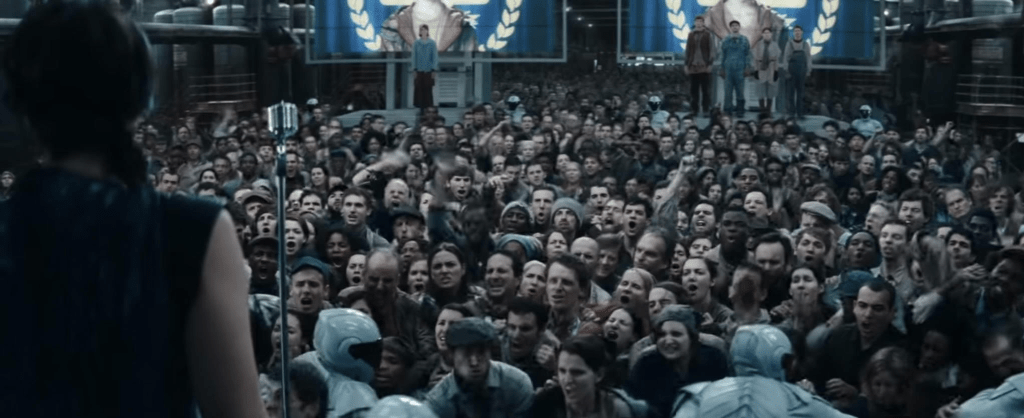
This is heavy on talking, but it holds you. It may be over two hours, but certainly doesn’t feel like it because it is not ploddingly slow. Each scene moves the story forward rather than existing to showcase the actor(s) present. Francis Lawrence does a great job of making you feel something significant is coming. And it’s mostly done without massive explosions or big action set pieces. Aside from the twenty minutes or so in the arena there is not much action at all.
Despite being the second in a bigger budget film series, this was done with an eye towards quality. They set the stage for so much more. The biggest thing for me about Catching Fire? It stands on its own despite being a sequel. You get enough of a recap of previous events that you do not necessarily need to have seen The Hunger Games to get what was going on. It is a bit of a lost art in filmmaking these days. That and they even manage a token ending which is even rarer. You’re more likely to see an honest politician than either of those in a single film.
The Hunger Games: Catching Fire is a fantastic follow-up to the first film. It sets the stage for a final confrontation yet stands as a movie unto itself. It is fantastic from start to finish and if you liked the first one, you’ll love this one.
 Warren Watched A Movie