

- Directed by Francis Lawrence
- November 10, 2014 (Odeon Leicester Square) / November 21, 2014 (US)
- Based on the 2010 novel Mockingjay by Suzanne Collins
Katniss becomes entrenched in the growing rebellion against the Capitol when she finds District 13 is not as gone as the world believes.
The Hunger Games: Mockingjay–Part 1 is much more heavily political with much more intricacies and plots and counterplots and dealmaking than any of the predecessors. Katniss (Jennifer Lawrence) develops as a character since she must learn how to play to her strengths as she becomes part of a revolution which is something she never wanted. And the story certainly sets up a final confrontation between Snow (Donald Sutherland) and Katniss. By the end of the movie their rivalry is much more personal than it is political.
Francis Lawrence and his crew do not shy away from the brutality of authoritarian governments. Snow comes down heavy on the population going so far as to wipe out anyone who does anything inspired by Katniss. Simply whistling the Mockingjay song is enough to get you killed. But he does not kill blindly. Rather his strikes are done to send a message to those against him.

Peeta (Josh Hutcherson) is tortured and tormented by Snow. The end result is that a clearly weakened Peeta is trotted out to the public via Caesar Flickerman (Stanley Tucci) to give interviews designed to spread propaganda to Panem (some of which maybe even the revolutionaries believe) and just undermine the will to fight. This movie continues a level of complexity not often seen in big budget productions.
There’s a feeling in the movie of things growing beyond the control of anyone as often happens in conflict. Despite the revelation of survivors in District 13, who have spent quite some time building up their military resources, you get a sense that no one is really in control of what is occurring. There are just sides hoping to come out on top.
I dare say despite its science fiction dystopian setting this is much more grounded in what happens than other films featuring revolutions. Some characters are conflicted while others see clear elements of good and evil in the conflict. Some embrace the cause while others ultimately have less than good intentions.
President Alma Coin (Julianne Moore), the leader of District 13, is portrayed just a shade better than Snow but can certainly be as cold and dispassionate. She views Katniss (Jennifer Lawrence) as almost disposable as well as untrustworthy when it comes to the revolution. This is in contrast to other films involving revolutions where good and bad are clear. It is less so here.
These are vastly more complex characters than what you normally get in a big budgeted film. And they don’t shy away from that complexity in this sequel. They don’t rely on events of the past moving forward to inform the viewer of the characters. Katniss and those around her grow as the story progresses. Things happen and they must react. And they don’t react out of character just to move things forward or create situations for dramatic purposes.
One thing that struck me was the strike on District 13. What became clear (and the characters realized) was that it was not a military strike to take out a target but a strike to figure out what the target was capable of. That is not only intelligent for the purposes of the story but very logical. The Capitol knew nothing about District 13 so they needed to learn what they were up against and hoped to provoke a response to estimate their capabilities. This movie has brains!
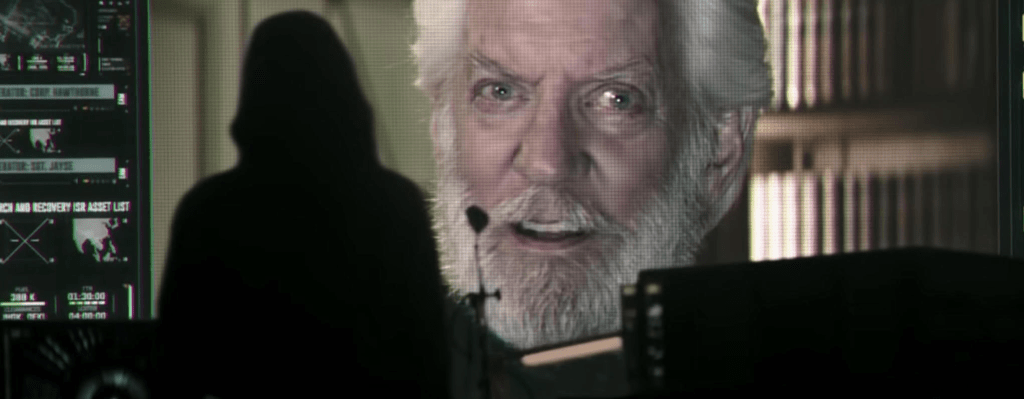
Snow becomes a vastly more complex villain. As Katniss’s stature rises, he grows in his evil. Donald Sutherland gives him a charm. You can’t look away from him. He doesn’t twirl a mustache, but Snow is just cold and calculating and sinister. He is single-minded and doesn’t care what he needs to do to accomplish his goal. No amount of blood is too much. People are just objects for him to use. And more importantly, he feels he is right. He’s not doing evil to be evil. He’s doing evil because he thinks he is on the correct side. That is what makes a truly great villain.
Francis Lawrence set out to tell a story rather than have a spectacle film. He was not trying to impress you with special effects, but rather engage you with a character driven narrative. This film is fantastically, acted and well told. The amount of talent present in this film is astounding. Beyond Jennifer Lawrence we have Philip Seymour Hoffman, Woody Harrelson, Elizabeth Banks, Julianna Moore, Donald Sutherland, and so many others.
And who can forget that song “The Hanging Tree.” It’s an excellent tune that actually lives up to what it’s there for. It’s presented in the film as becoming an anthem for the revolutionaries. It is emotional and moving.
One thing this movie does right that the others did right is give enough of a token ending that if for whatever reason there wasn’t another movie to come you would have a sense of completion of the story. You could at least see where things were going and what they had presented was enough of an ending that you could feel that while you may want more, it wasn’t more was not necessary.
The Hunger Games: Mockingjay–Part 1 is a great film that sets up so much at the same time as paying off much of what is set up. Well worth your time.
 Warren Watched A Movie