
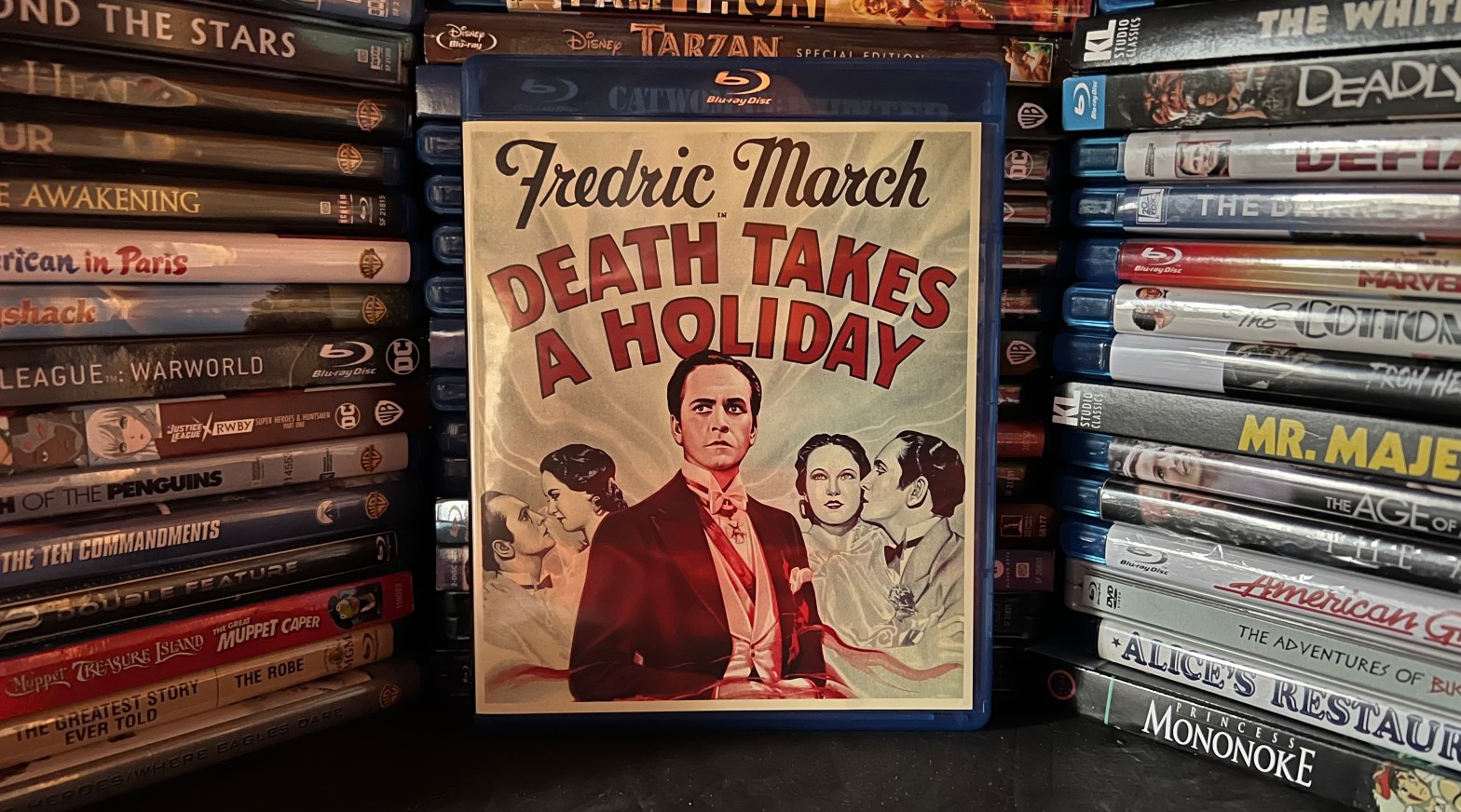
- February 23, 1934
- Directed by Mitchell Leisen
- Based on the 1924 Italian play La morte in vacanza by Alberto Casella as adapted into Death Takes a Holiday in 1929 by Walter Ferris
After questioning why people fear him, Death takes on human form for three days so that he can find an answer to that question.
My first viewing of Death Takes a Holiday was on PBS decades ago and it stuck with me ever since. It was maybe the early 80s when I first saw it but something about this presentation lodged itself firmly in my psyche and never let go. It was unlike anything my young eyes had seen. So here I am pushing 40 years later watching it only for the second time ever. My adult sensibilities and nostalgia for my youth are colliding a bit here.
One thing you will notice when watching this is there was a real economy of story in this movie. That was pretty common in older films-for better or worse. While some older films like this certainly benefited from few extras, others could’ve certainly benefited from a little bit more than what they presented. Then again in the very early days of motion pictures these script writers and directors were often pulled from the theater and that’s a much different way to tell a story than in film.

This whole film is well acted in the context of the predominant acting style. Today it comes off as mild camp but was never intended as such. This occurs in a story with the most minimal of fat and that does have any parts that lag. The economy of story is a great benefit here.
For the time the personification of Death meeting people and finding love seems rather dark and I find it is shocking that Death Takes a Holiday got made. Things that would be more directly addressed today could not be so easily spoken of in the mid-1930s. They do a fantastic job of dancing around the even mildly sensitive language (by modern standards) needed to tell the story and get certain points across. They cannot spoon-feed everything to the audience but rather needed to be careful as they presented what they did in such a focused fashion and don’t waste time.
The ending is darker than one would expect if you take time to think about it even a little bit. By the closing minutes everybody now knows that Death (Fredric March) is posing as Prince Sirki who is the deceased friend of Duke Lambert (Guy Standing). Everybody that is but the young Grazia (Evelyn Venable) with whom Death-as-Sirki has fallen in love and by doing so gained a greater understanding of humans and their love of life.

It is a delicately and carefully crafted scene where Death-as-Sirki is trying to convince Grazia to come with him which she eventually does after realizing he is Death. And she cannot go as is (i.e. alive). When you think about it Grazia committed suicide to be with Death. The scene itself is sweet and dark and maybe even morbid for the aforementioned reasons.
What is impressive is a little better than an hour they conveyed a mostly believable romance with the culmination of the plot packing something of an emotional punch. These are the only two that can truly understand each other.
The humor though mild by today’s standards is on the dark side. For the three days Death is human, nothing causes death. Gunpowder on the battlefield fails to work. A jockey gets trampled on a racetrack but walks it off. And so forth.
Fredric March is an appropriate level of creepy without being too goofy. His Death is unsure of how to interact. He’s been on the outside looking in for so long and can only take it so far. I do draw issue with his closeup facial expressions which felt like they channeled Dwight Frye in Dracula. Then again this was made in the wake of that groundbreaking film and that aspect of his performance could be influenced by Dracula’s success on some level.

One thing that does bother me about this movie is that Death makes the usual stupid type of verbal mistakes that should be a huge tip off to everyone that something is not quite right but the characters don’t generally pick up on it for some reason. That’s always been a nuisance. I get that the inclusion of those mistakes are designed to add a little tension to the story, but at the minimum logically it should make characters go “He’s weird.” There is no amount of explaining away to make those instances forgettable.
Maybe though not all are ignorant of what is going on. Henry “Clarence Odbody” Travers is Baron Cesarea and does seem to kind of understand what the real deal is with the man posing as a foreign dignitary, but they never quite have him overtly come to the realization. I’m not saying he had to run around screaming that Death was hanging around the house as a foreign prince but something a little more indicative of that realization than just a possibly vague suspicion. Maybe confront Death-as-Sirki through some double meaning dialogue.
Given that this was made in 1934 the effects are not exactly great. It’s some bad camera trickery and I’m pretty sure that shadow of death that we see is not just somebody dangling a filter over the camera lens. While the special effects certainly do not impress in the modern age, the story is focused and to the point and sweet yet with an undercurrent of dark that should certainly entertain anyone who watches. It’s an unusual romantic film even for this time.
Death Takes a Holiday is certainly worthy of a watch. You will enjoy yourself and certainly put this in again to view. I highly recommend it!
 Warren Watched A Movie