

- Directed by William Dieterle
- December 29, 1939
- Based on the 1831 novel The Hunchback of Notre Dame by Victor Hugo
In 15th century France a young Roma woman is framed for murder by the lustful Chief Justice and only the deformed bellringer of Notre Dame Cathedral can save her.
The 1939 version of The Hunchback of Notre Dame is the kind of meaty movie that can be enjoyed whether or not you necessarily agree with what it might be saying. For me there were themes of the past needing to give way to the future though not necessarily ignoring the past. There are discussions among the characters of individual freedoms and that the spreading of knowledge can be a way to do that. For the time that’s some serious stuff. The story also includes themes of classism and how the ruling class can neglect the common man. The best known character of the story is an innocent person in a deformed body and often sparks discussion or debate on the poor treatment of the average citizen.

There’s something innocent from the start about Charles Laughton’s performance. Quasimodo is simple and quite harmless despite his fearsome appearance. The make-up is quite excellent. The only thing that could’ve made it better was the false eye moving but given that the time this came out that was a technical impossibility. You are so taken in by the film as a whole it is hard to notice. Quasimodo speaks very little in this. Much of what we get about the character comes from his actions or the perceptions of what other characters believe/know about him.
The villainous (and disturbed) Frollo (Sir Cedric Hardwicke) represents the past desperately clinging to power and trying to block any advancement. With a sneer and a condescending look you know he’s an a-hole from the start. With him the story delves into bigotry via his persecution of the local Roma.

Maureen O’Hara was always stunning and a gifted actress as well. She brings a level of the exotic to her Esmeralda. Frightened yet brave. Strong yet caring along with the hint of something mysterious. She is enchanting and sometimes haunting.
There is a love triangle involving Esmerelda, Captain Phoebus (Alan Marshal), and the street poet Gringoire (Edmond O’Brien). I do not know if this is present in the book. Who Esmerelda winds up with felt rather random and I was left thinking the presence of a romantic plot of this kind was a product of the era as was the portrayal of King Louis XI (Harry Davenport) who was the kindly old man meant for comic relief often found in older films.
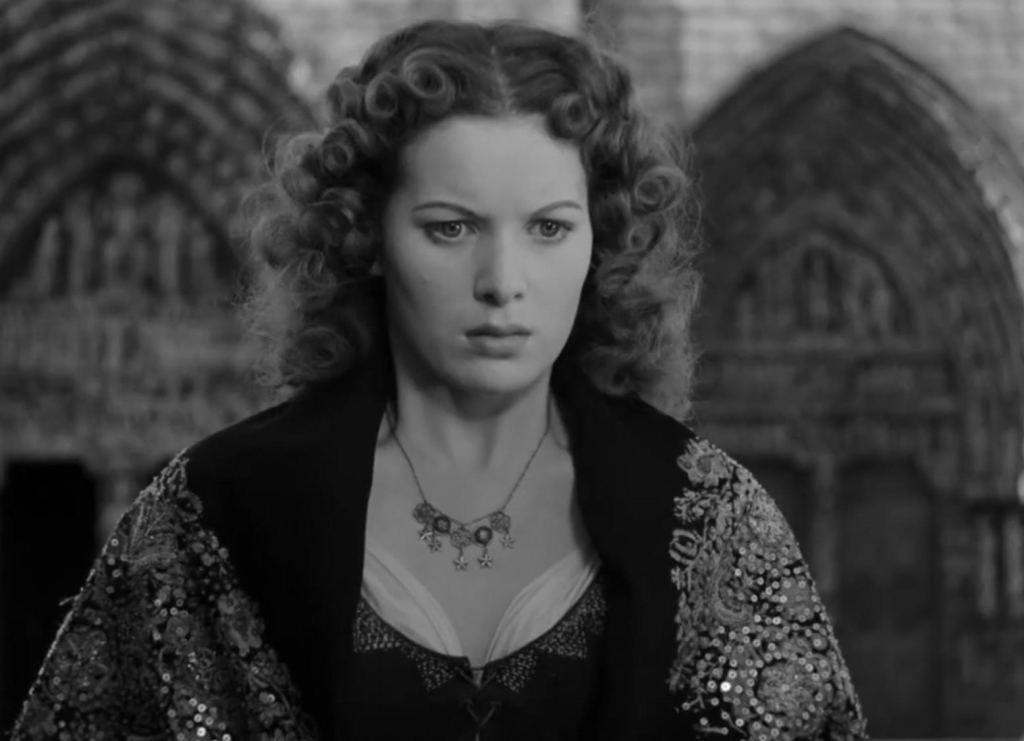
There is a strong contrast between the ‘heathen’ Esmeralda and the ‘Christian’ Frollo. While Frollo superficially embraces Christian principles and the social ideals of the day Esmerelda is much closer to actually living them even though she doesn’t know specifically what they are. It takes a little bit before we experience Frollo’s lust for Esmeralda getting wrapped up in his internal evil. Rather than confront those feelings and his own shortcomings he decides the easiest way to deal with it is to kill her.
Eventually the people rise up in defiance of the government. Those that are supposed to look out for them are not so they have taken it upon themselves to ensure what is right happens. A little commentary there I guess. It strikes me as a little contradictory because while they are doing that Quasimodo is protecting Esmerelda and they are storming Notre Dame in part to save her. They see him as a threat too. Is this a comment on how the masses with the right intentions to do the wrong thing? Or did I miss something?

We get a climactic final confrontation between Quasimodo and his adopted father. It’s muted by modern standards with some unintentional comedy when viewed today. The funny part is how Frollo screams when Quasimodo tosses him over the balcony. I just lost it. I laughed at the whole thing because it was a silly scream. He sounded like Goofy when falling over a cliff or off a building.
Despite that larf The Hunchback of Notre Dame contains a rather down the ending. For all the good that Quasimodo has done, the final shot of the film shows him essentially isolated and alone much as he was before. Perhaps more so. Heartbreaking.
The 1939 version of The Hunchback of Notre Dame still holds up today. It’s exciting and passionate.
 Warren Watched A Movie