
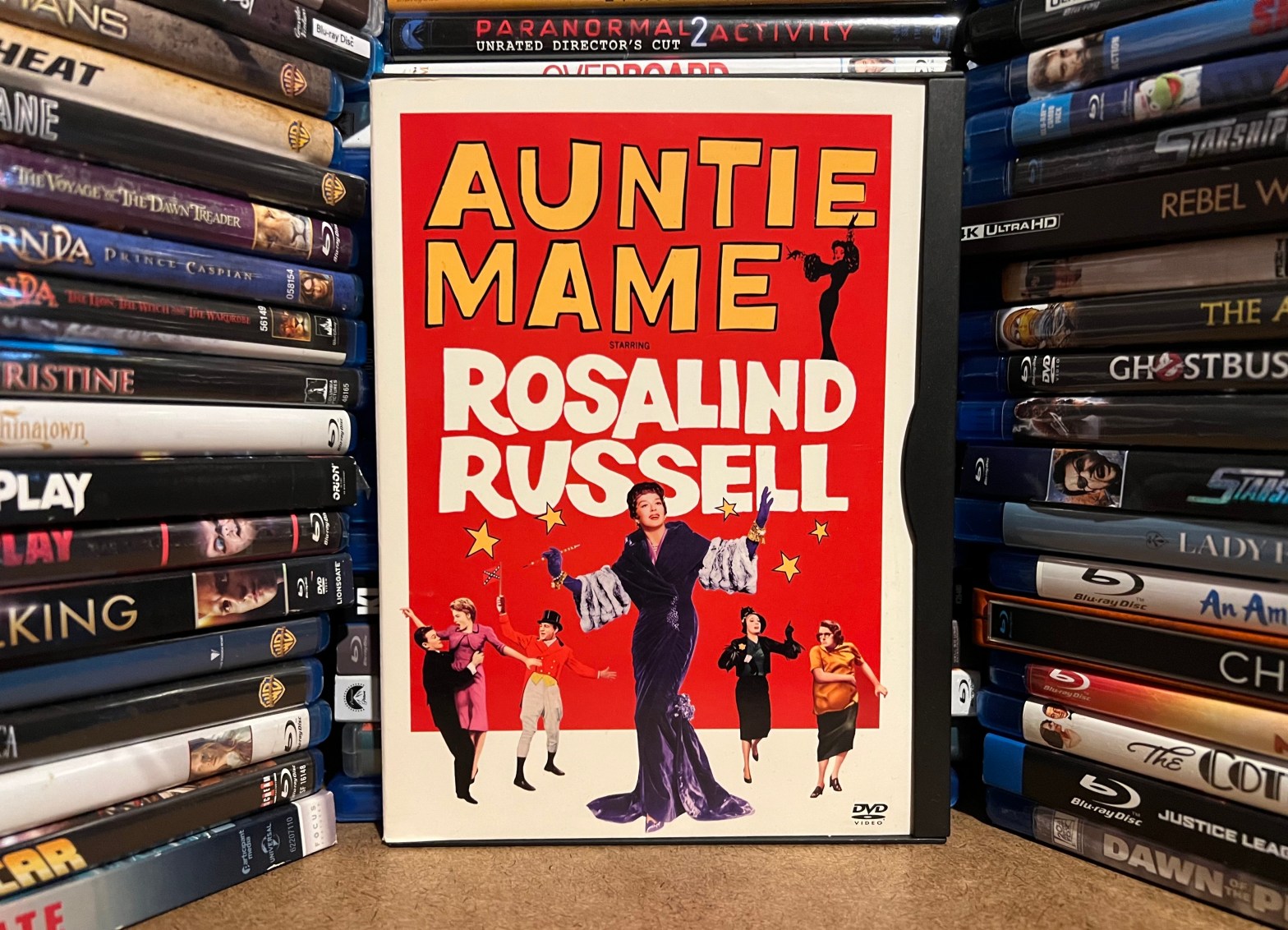
- Directed by Morton DaCosta
- December 4, 1958 (Radio City Music Hall) / December 27, 1958 (US)
- Based on the 1955 novel Auntie Mame by Patrick Dennis and the 1956 play Auntie Mame by Jerome Lawrence and Robert Edwin Lee
When an orphan goes to live with his free-spirited aunt, there is conflict when the executor of his father’s estate objects to her lifestyle.
Auntie Mame is a culture clash comedy. It’s the free-spirited Mame Dennis (Rosalind Russell) versus the conservative leanings not only of her late brother but of Mr. Babcock (Fred Clark) who controls the purse strings while the retired actress provides a roof. “Life is a banquet and most poor suckers are starving to death!” is a quote by Auntie Mame spoken often by hers or paraphrased by others.
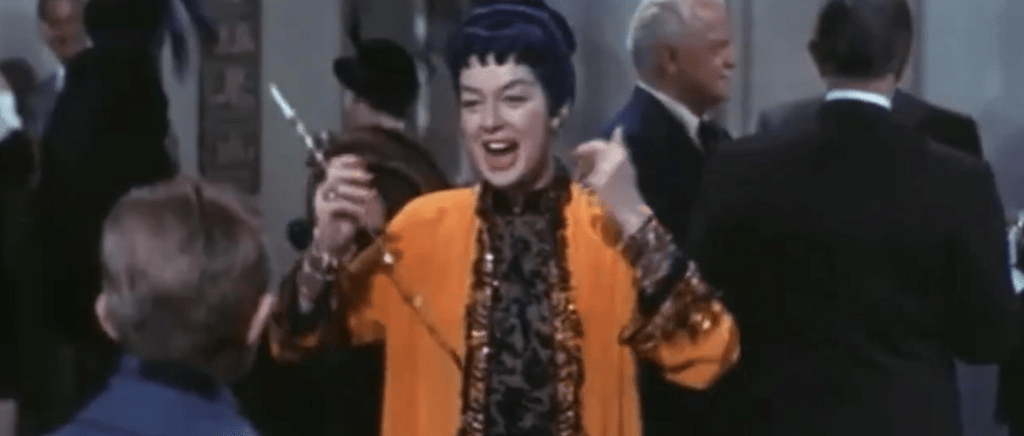
Russell is extremely over the top in her portrayal of Mame as is required of the role. Mame is aloof and energetic. I think she comes on a little too strong here or there but that’s more about me than it is about the performance I think. She’s a larger-than-life personality. Eccentric and curious and often like a cat with a laser pointer. There can be a bit of bite to her wit when she encounters a person or situation she is adverse to but her love and loyalty is unwavering. Russell having originated the role on stage effortlessly transitions from the lighter moments to the more serious all the while making her instantly endearing.
Mame finds something that is missing in her life in the form of her nephew Patrick (Jan Handzlik-younger/Roger Smith-older) whom she has never met. It’s never outright stated but obviously she was so distant from her brother that he never brought the boy around. Why? That is a weighty bit that gets rushed past. But not the only thing rushed over in this story.
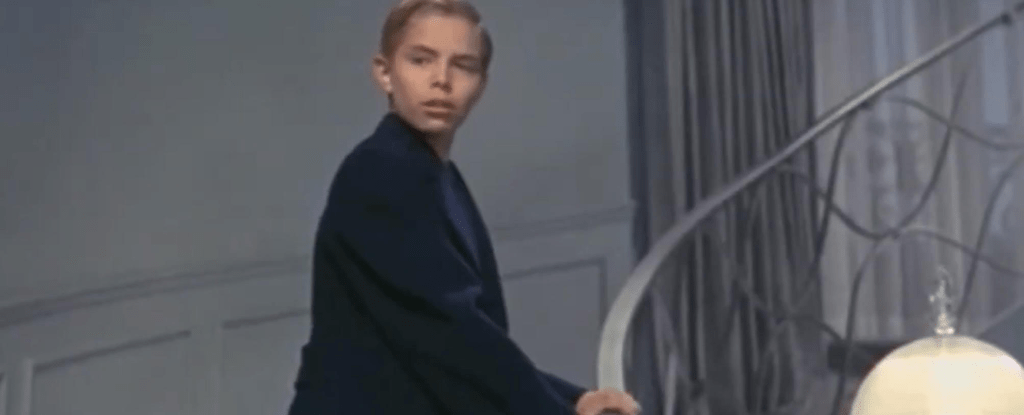
Nephew and aunt quickly bond, but that bond never gets really displayed. There’s a moment where she looks at Patrick when she puts them to bed for the first time in. It’s meant to indicate that she loves them but they don’t do too much to build up their relationship before that. Suddenly they’re close. It’s annoying, but not harmful. With both actors that play her nephew Russell was able to convey a love and affection for the boy.
Auntie Mame is actually quite funny. Some of it might be a little tame here or there but the jokes still land all these decades later. There is some really dark humor. They make jokes about the suicides of the stock market crash. Death is even a punchline to a setup. You will laugh out loud at much of the humor. It’s silly or bordering on slapstick while others are witty bits of dialogue.
Forrest Tucker plays Beauregard Jackson Pickett Burnside who falls for Mame during the height of the Depression when she is at her most destitute. He is charming in the part, and I was pleasantly surprised. I’m not used to him putting on such a performance. There is that easy sweetness that makes the love interest so believably plausible. He’s at times uncertain of himself yet there’s an overbearing confidence that draws the viewer to him. Not that the relationship lasts. His death is one of many dark jokes.
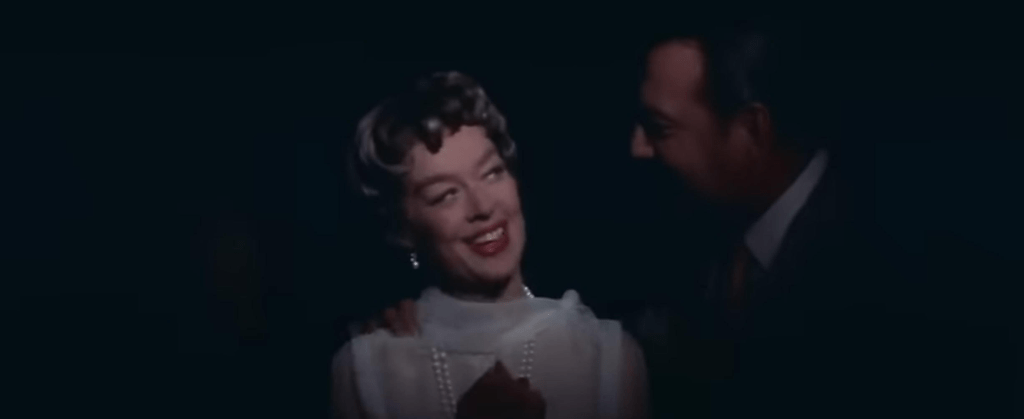
There’s a great deal of Auntie Mame filmed on sets and they use that to great effect. Stage lighting is used to focus the attention of the viewer by highlighting a reaction. This began as a Broadway show and director Morton DaCosta uses techniques that would have been done there to add punch. He even uses the changing of the appearance of Mame’s apartment as an indication of the passage of time.
This is a movie that is still enjoyable today. Most of it will not bother a sensitive viewer. Most but not all. Only thing that might offend the modern audience is the portrayal of Mame’s servant Ito (Yuki Shimoda). Most of it comes down to the accent though nothing he does nor Mame’s treatment of the character is bad. Just recall they were speaking to a different audience than today.

This connects to the general enlightened attitude of the film and what it has to say about the era. There is talk of restrictions which were a thing back in the day where groups would be excluded from certain areas. They became a little more vague yet still enforceable as anti-discrimination bills were passed. “You don’t want the wrong kind of people” here or there-whatever that means. Mame to use a modern word is a bit progressive and sees people as people.
She is even so open-minded for the time that she takes in her now pregnant and unwed former secretary Agnes Gooch (Peggy Cass). This pregnancy made her a social outcast of the time. Her predicament is Mame’s fault in a very overt way though Mame displays little guilt and suffers no consequences. Agnes was hired to take dictation of a forthcoming book by Mame who is being assisted by Brian O’Bannion (Robin Hughes). Mame eventually takes up with the gold digger but dumps him when he comes between her and her nephew by tricking him into hooking up with Agnes. But she never catches heck for setting up a situation that ruined someone’s life.

This is a story that covers many years in a two-hour long presentation. It takes in a lot of life and some things get a little shortchanged here or there but overall it has a good message when it chooses to have one. Live life and don’t be a snob or a bigot. Mame is accepting of everybody until they display classism or racism after which she turns into their enemy and you either change or you continue to get crap from her.
Mame was a hilarious discovery for me. It’s funny and heartfelt with great performances all around. Maybe not perfect but those imperfections are overall not harmful. If you want great comedy you cannot go wrong here.
 Warren Watched A Movie