

- Directed by Jean-Jacques Annaud
- September 19, 1986 (United States) / October 16, 1986 (West Germany) / October 17, 1986 (Italy) / December 17, 1986 (France)
- Based on the 1980 novel The Name of the Rose by Umberto Eco
A Franciscan friar is asked to solve a deadly mystery occurring at a medieval abbey.
My tastes have grown as I have aged. While I was not necessarily against something that looked mature, intelligent, or deep in my youth I would pick a mindless action film over any of that. In that vein I repeatedly ignored The Name of the Rose on those weekend movie marathons that I have often mentioned here.
Yet here I am having finally watched and having enjoyed it. It is unique in my experience. It is a mystery set in a medieval abbey with Sean Connery as Franciscan friar William of Baskerville (see what they did there) who is a medieval Sherlock Holmes. Intelligent and intelligently crafted. The Name of the Rose is a mystery that you must pay attention to and decipher the clues.
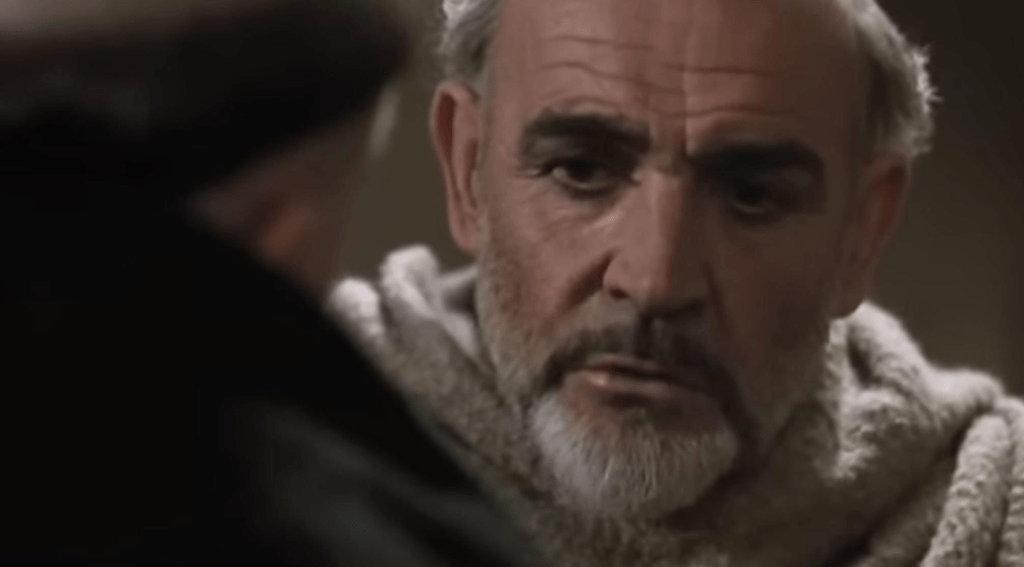
Sean Connery is an excellent detective monk. See what I did there. Connery could have read the Help Wanted section and made it riveting. His character parses the truth from the minutest details that he picks up from careful questioning. He investigates and collects evidence and draws conclusions. He is a man with a past, but only one that he finds shameful because of what he did.
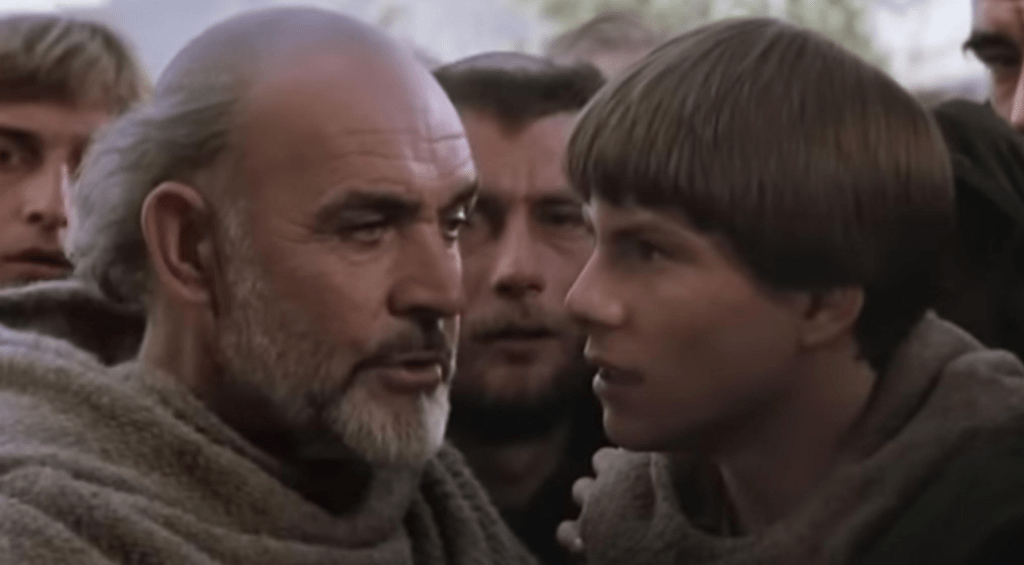
Following along is the young Adso of Melk (Christian Slater) who is the youngest child of a prominent family. Adso is joining the clergy and his time with William is part of his investigation. Slater was a rising star at the time though not nearly as polished nor able to give the weight or gravitas to any line that Connery could. He admirably steps up to the task and avoids fading into the background during the movie.
After a young illuminator at the Abby apparently commits suicide, William convinces the Abbot (Michael Lonsdale) to allow him to investigate the deaths with Adso following along as part of his aforementioned education. Over the next several days more bizarre deaths occur hinting at a much larger mystery. The first Bond is paired with an actor that played a villain that faced off against the third Bond.
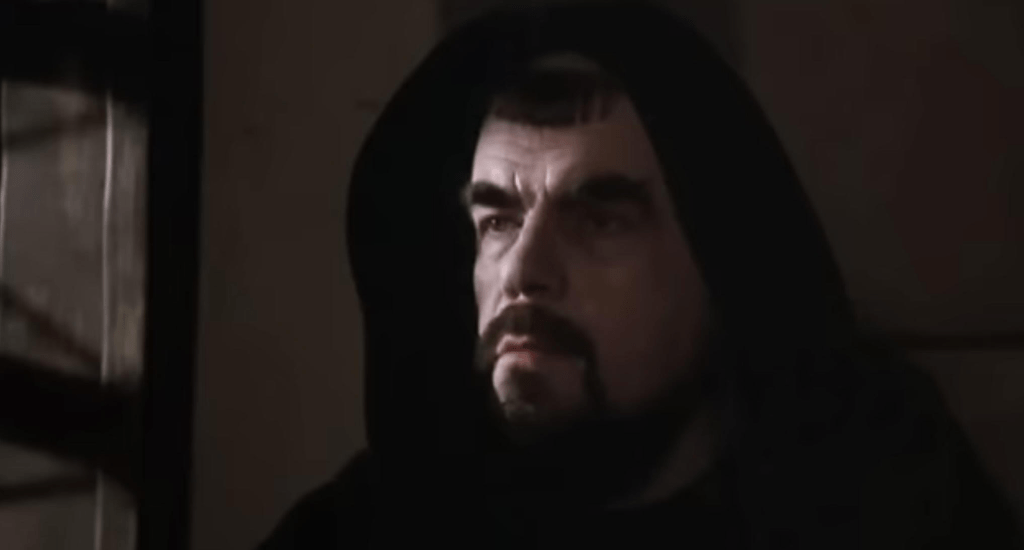
The Name of the Rose mixes historical fact and fiction. Some of the individual characters are based upon real people while others have pasts tied to historical events though this set of events is complete fiction. The mystery is built around hidden knowledge which is exemplified by the discovery of a mysterious library and a lost book of Aristotle which Jorge de Burgos (Feodor Chaliapin Jr.)-a particularly decrepit resident of the abbey-thinks is heretical and has taken certain steps to prevent the knowledge contained within from spreading.
Ron Perlman is in this as the hunchback Salvatore. Somehow they managed to make the man even uglier than he normally is which I guess was the point. Anywho there’s a veritable group of Who’s Who of character and supporting actors from the time. William Hickey as Ubertino of Casale is the only one I can definitively name but scene after scene has somebody you have seen elsewhere even if you do not know their name.
Given a few things early on I thought The Name of the Rose was going to be all about sexuality. While there is some of that the ultimate point of the movie is about control. Specifically control by the Catholic Church through fear. The story takes a very dim view of Catholicism and religion in general but story came first here. Unlike many more recent movies they were not out to tell their message but to tell a good story with their message in it.
There are definitely hints of homosexual love along with the love of knowledge and the love of truth. Maybe even the love of control. There’s a lot to this movie. And because you can find a lot in The Name of the Rose, it hooks you from the start. It’s not a shallow dissertation or a long lecture.
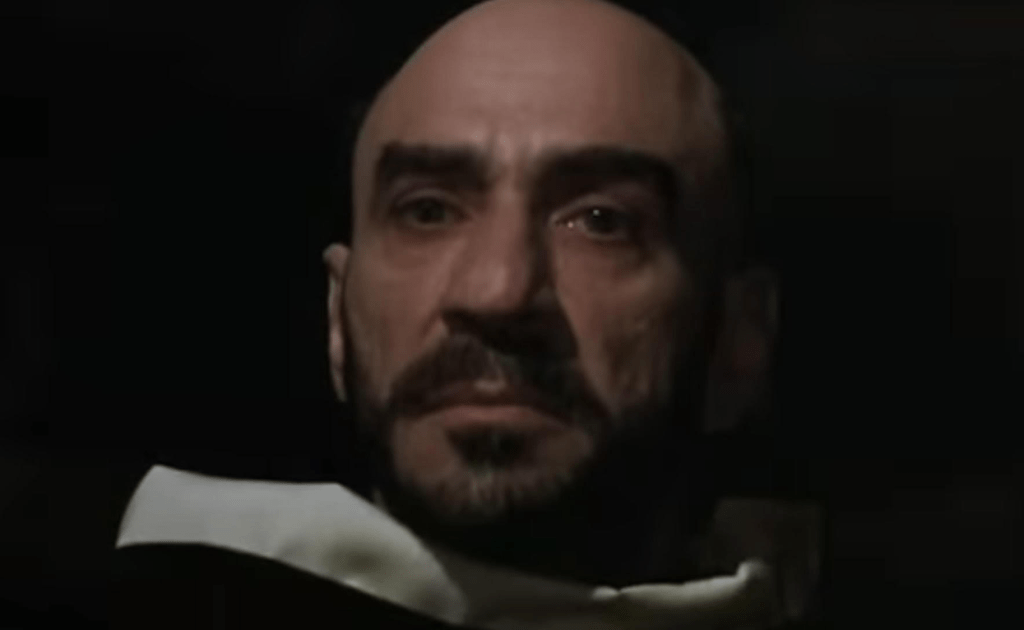
While the Abbott is an authority figure, the representation of control comes in the form of Bernardo Gui (F. Murray Abraham) who is an inquisitor for the Church and based on a real-life person though not historically accurate. Bernardo Gui is a secondary antagonistic for the film and comes in towards the last third of the movie. He decides on what the truth is (which benefits the Church) and not only derails the ACTUAL discovery of the truth. Instead he riles up the local population bringing up buried hatred and resentments.
As I said before it takes a dim view of religion and Catholicism. Religion should be gotten rid of! In the view of the film it stifles and corrupts and isn’t good for the people. The surrounding peasants get food from the abbey much like stray animals might.
To drive that point home in the climax the locals rebel against religion, against the local abbey, and demolish everything with additional damage done courtesy of a fire started by Jorge de Burgos. Bernardo Gui gets carried off and presumably killed by the locals. Burgos dies as well. It avoided any kind of actual justice or repercussions in the real world for the characters behind the deaths or for anything they may have done.
I enjoyed the movie throughout. Even the ending which I found a little lazy did not hurt it. I just would’ve liked to have seen something else. Killing all the bad guys and burning the library does not take much creativity. It does avoid the problems with maintaining authenticity/realism though given they killed one character that died peacefully and not at the hands of the enraged masses.
Despite the lazy ending The Name of the Rose is a great film. It’s a mystery with an unusual setting and is an engrossing watch.
 Warren Watched A Movie