

- Directed by Joachim Rønning
- October 6, 2025 (El Capitan Theatre) / October 10, 2025 (US)
- Based on characters created by Steven Lisberger and Bonnie MacBird
A highly advanced military AI called Ares is part of a company’s efforts to bring programs from the digital to the physical world.
So I decided to take in the rather divisive Tron: Ares. I’m always up for a science-fiction movie though given the reports that this one contained no Tron (Bruce Boxleitner) or returning characters from Tron: Legacy caused me to go in nervous. Such things done in sequels were once reserved for direct-to-video but now are worthy of $200 million franchise projects.
I was not pleased with the opener. In Tron, Kevin Flynn (Jeff Bridges) was an employee of ENCOM who created games that were then stolen by Edward Dillinger (David Warner) who used their success to rise to the top of the corporate hierarchy. At the end of that movie and mostly confirmed by Tron: Legacy, Kevin Flynn not only got Dillinger’s job, but eventually gained control of the company.

I bring this up because they open this movie with an information dump to bring the audience up to speed and incorrectly state that Kevin Flynn started ENCOM in his garage. He was merely an employee. Dr. Walter Gibbs (Barnard Hughes) was a founder. When a film begins not knowing its own topic, that’s a massive red flag. Tron is not some expansive fictional world. It is (now) three films and a noncanonical animated series. This oversight says director Joachim Rønning and screenwriter Jesse Wigutow did the barest of research.
Sam Flynn (Garrett Hedlund) is no longer running ENCOM having retired for ‘personal reasons.’ He along with Quorra (Olivia Wilde) are present in Ares though only in the occasional headshot or tightly cropped screen capture from Legacy. Given the plot of this movie involves bringing anthropomorphic programs into the physical world their absence makes certain difficulties a factor so the plot can happen. Quorra started out as a program with the info in Flynn’s identity disk making it possible to become physical. It was the whole reason the movie’s villain CLU was after him because HE wanted to become real and bring his idea of perfection to the physical world.
It would have made sense to get them for a few token scenes to either take them off the board or to explain why they were never tapped for this company project. We could even use a few lines to explain their absence beyond ‘retirement’. Something that makes them inaccessible. That is kinda unimportant since it appears now the corporate world has some knowledge of their realities of the digital world.

ENCOM is now run by Eve Kim (Greta Lee) who is still dealing with the death of her sister who also ran ENCOM. Being a responsible CEO in mourning she has run off to search an old computer system at a research station set up by Kevin Flynn in Skagway, Alaska in hopes of finding a permanency code that everybody assumes was secreted away for no reason ever offered. She and a guy I would not trust to run a cash register bring a digital orange tree into the real world in the first of several nods to the first Tron. There is also seen a ‘Dumont Recycling’ dumpster which tells you what they were trying to do here. Being the noble good guys they are striving for a post scarcity world.
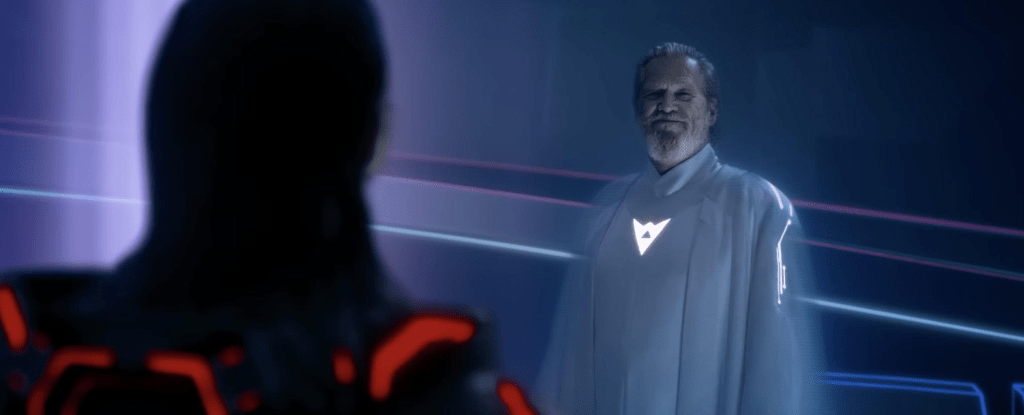
The appearance of Flynn (Jeff Bridges) was nice in the presentation of the original Tron aesthetic merged with the dress of the character in Tron: Legacy. It was one more in a long line of things meant to connect to the first film while skirting the elements of the second that should have been included here. It was a bit of fan service for a Jeff Bridges appearance. They couldn’t even give us a CGI Bruce Boxleitner lingering around like some kind of bodyguard?
Lee is about as wooden and fake as anything in the virtual world. Lee delivers lines more stiffly than anything completely AI generated not showing desire or ability to create a character. This is who you cast as your heroine? She must have an amazing agent to keep getting work.
In Tron: Legacy Cillian Murphy made an uncredited appearance as Edward Dillinger Jr., the son of Edward Dillinger Sr., working as a programmer for ENCOM. Does he show or get mentioned as a character? Nope! Instead we get Dillinger’s GRANDSON Jullian (Evan Peters) who replaced his mother Elisabeth (Gillian Anderson) as the head of the very well-established Dillinger Systems engaged in a race against time to do the same thing as ENCOM but for military purposes because they are evil. It begs the question of why was the son working for the enemy company when daddy had gone on to start another company despite the presumed shame and distrust and criminal charges that most likely came from his activities in Tron?
Jared Leto aside, Gillian Anderson is probably the biggest name present. She has little to really do and adds almost nothing special to the plot. She’s the mom with a conscience which given what she does could’ve been played by any nameless actress. She scolds her son for his recklessness and eventually dies. End of line.

Jullian as a villain is just a bratty child. He’s all tantrums but no genuine threat level. Someone saw Kylo Ren and decided to use that. If he maybe had a parallel in the computer world it might’ve been a little more interesting. Most of the characters there though are helmeted drones other than Ares and Athena played by Jodie Turner-Smith who brings the same magic she brought to The Acolyte as Mother Aniseya to this.
The problem everyone is running into is that creating something from nothing only lasts 29 minutes before it falls apart. Julian is convinced ENCOM is close to or has the answer (which is both) so on a few occasions he deploys programs from a facility of indeterminate location in relation to the indeterminate city this largely takes place in. Those light cycles may be fast but unless their transit time borders on instantaneous 29 minutes it strikes me as insufficient to engage in anything they do. Ticking clocks need to mean something when used but also allow enough time for stuff to logically happen.
As a story the rules of Tron: Legacy felt like it fit with Tron. This seems like the mockbuster version of Tron at times. Sometimes Jullian types to Ares and at others he speaks. The light cycles break space/time but characters are limited by physics of a type. It knows the appearance, but it doesn’t know the heart.

Of the programs we meet this time around they are a little more or less developed than Data from TNG was in comparison to the first two which occurred in two different systems. Before they were more like human beings. Ares (Jared Leto) does not understand rain and looks on the verge of asking “What is love?”
Ares is a program created by Julian as a foot soldier or MCP as needed for the story. His initial sign of being open to change/growth comes from seeing said rain. What really begins his change are pretty words he finds online spoken by Eve Kim. He goes through tons of her files about her and it’s all these wonderfully sweet things. What really turns him is how awesome of a person she is when they finally meet. No actual growth.
The dialogue does this no favors. It is often of the MCU level where it is quippy and occasionally self-referential with humor that undermines every moment since they are indicative of punchlines. The more you watch this the more you may think like I did that they simply re-purposed a script that once featured the character of Sam Flynn into one at the minimum with Kim/Ares at the center.

For a movie that is about a parallel reality, it takes forever before we get into the virtual world. By the point they finally get to it that world feels so small and insignificant. In the first two films it was a lived in reality. Here it’s almost a side project with a nice view. What was once a parallel world is now just a small room. Gone are the wide shots and indications of a larger population. We see plenty of buildings and objects but not background characters. Both films made you feel like there was a larger reality. What was once something existing in a large computer is now something existing on a laptop.
Eventually Ares having been changed to a good guy after watching all the different images plots with Eve after she’s taken onto the grid to escape and become real. For a character able to craft machines as needed while on the grid, he doesn’t think create a superior vehicle when they’re escaping but instead chooses to ride his water-based craft to do whatever is needed?
As controversial as this may be to some, I do not think Jared Leto was the problem. His character has multiple good moments which is probably helped by him being a producer on Ares. Plus his work is better than the rest of the main cast. In a better script he could’ve been a quite enjoyable character.

Jared Leto is a good actor that chooses bad projects. He’s trying to get into the comic book movie level money or just a steady paycheck by being part of a franchise and can’t quite do it. I may not praise Morbius, yet I think he was good here. I think Leto elevated what he had into something far better than those around him could or would do.
The treat of the movie should’ve been the climax at the end where all these computer programs make it into the real world. That should’ve been a moment that put you on the edge of your seat thinking ‘we are screwed’. It didn’t because it happens so much in smaller doses throughout the movie before then. It wasn’t the coup de grace, the icing on the cake that it should’ve been. The potential of programs that were unstoppable by human standards was the main threat of Tron: Legacy. It all falls apart and amounts to nothing here.

Sometimes movies are not densely packed and that can be okay. The first and foremost thing of any film should be to entertain in whatever way those behind it intend to entertain. The problem here is this is densely packed and not a lot of it is good. There is some quality amongst what you get but so much of it is just weak and not well done.
Tron: Ares was a seriously missed opportunity. The big moments were not big, and the majority of characters were crap. Things that should’ve been in play introduced in the second movie were conveniently off the board here. And the vastness and possibilities that the first two movies evoked were absent in a film with a big budget that feels very small.
 Warren Watched A Movie