

- Directed and Produced by Joseph L. Mankiewicz
- September 19, 1970 (France) / December 25, 1970 (US)
A charming and ruthless criminal in an Arizona prison enlists his cellmates in an escape attempt by using the promise of sharing his hidden loot.
There Was a Crooked Man… is packed stem to stern with top-tier talent of the time. Kirk Douglas, Henry Fonda, Hume Cronyn, Warren Oates, Burgess Meredith, John Randolph, Lee Grant, Alan Hale Jr., and Victor French as Whiskey though I will be darned if he had a line of dialogue. Yet not one is given an excessive amount of time to justify their presence. It is only what is necessary for their character or the plot.
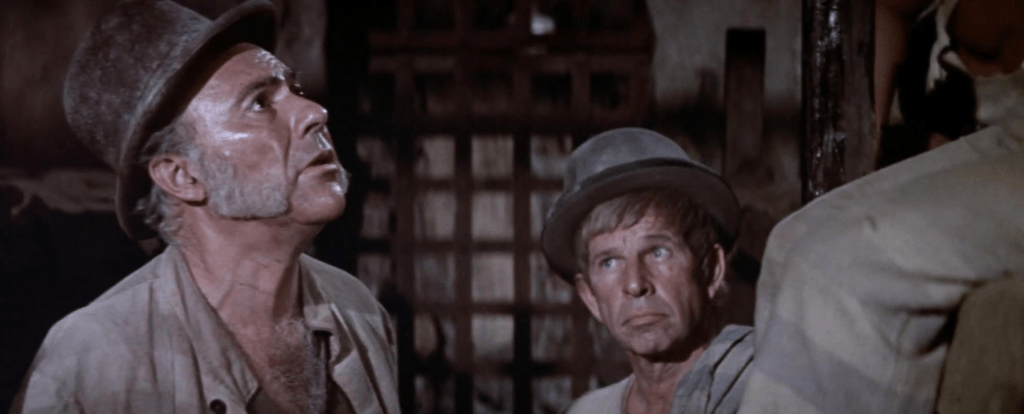
One thing that jumped out of me immediately was the amount of implied homosexuality in this 55-year-old film. It was the con artist duo of Cyrus McNutt (John Randolph) and Dudley Whinner (Hume Cronyn) who are clearly a gay couple. There’s also a prison guard that keeps telling the young and attractive Coy Cavendish (Michael Blodgett) in jail for an accidental death of a powerful man that he could have things easy implying there’s a sexual way to make that happen. but unlike today it’s alluded to because of sensors of the time. Thing is it works so much better than handing it to the audience. Why? Because it’s simply a fact of life presented as a fact of life and not highlighted as an instance of representation of any kind.
Kirk Douglas is charming as an a-hole criminal and casual murderer sent to jail after hiding $500,000 which is a huge amount of money for the time of the Wild West. Why did I say casual murder? Because to get away with that money all for himself in his first scene he shot at least one member of his gang in a shootout during the robbery. Not by accident but on purpose.
Billed as a comedy in the streaming service’s description, There Was a Crooked Man… makes swings between humor and downright darkness. It does so quite smoothly. It doesn’t create an uneven tone but turns what could be very dark and downbeat into more of a light drama.

The story splits between melodrama and mild satire. The humor can be a bit broad such as when The Missouri Kid (Burgess Meredith) took a wee while bathing or the general old couple style bickering of McNutt and Whinner. That is mixed with the more serious elements of The Missouri Kid having long ago given up as indicated by an imaginary farm he tends to or the fear of Coy with his imminent hanging fueling his desperation to escape.
The movie revolves largely around the dynamic of the planning of the escape Pitman (Douglas) and his interactions with the new warden Sheriff Woodward W. Lopeman (Henry Fonda). Lopeman is a reformist and has high minded ideals to turn these hardened criminals into productive members of society. Pitman is pretty much seeking to take advantage of that. There is a little cat and mouse between the two but it is mostly Lopeman acting as if he has the upper hand.
Lopeman is preceded in the position in the film by another man who makes a deal with Pitman to get the money and get out. I have no idea what made him a necessary character to show. At a good 126 minutes he added nothing really to the narrative. For the purposes of the story the initial scene in the prison between Pitman and Lopeman and Pitman’s explanation of the situation was more than enough.
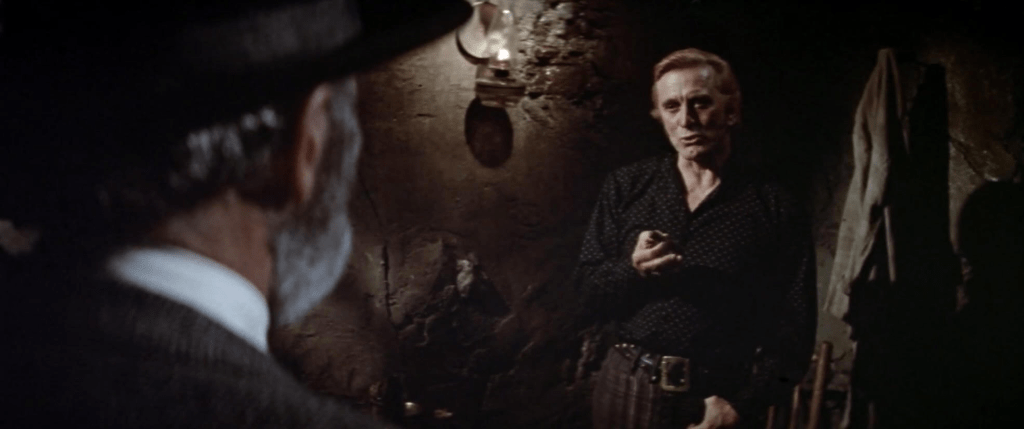
Joseph L. Mankiewicz manages to convince the audience that there is a real chance most or all will get out though the possibility of that actually happening is shown by Pitman gunning down his own men in the heist that got him jailed. The individual realizations by the cast of characters that they were played has some emotional impact. Pitman built relationships and made authentic feeling connections. The Missouri Kid believed he could finally get that farm, McNutt and Whinner thought they could build a home, Floyd Moon (Warren Oates) is shocked to be betrayed by a man he thought was his friend, and so forth. Each learns it is one elaborate con on them.
Lopeman is the closest thing we get to a hero here. Of the characters he is the only one to survive AND get the money. During the story he has dealt with those who did not believe or like him. I thought his ending was a little out of character. While he does have an axe or two to grind, he’s been this upstanding lawman yet he rides off with the cash. I have a hard time seeing him doing that. It just does not fit the character.
I can’t say hated this movie. I enjoyed myself and it was good for what it was. I just wish it had gone fully dramatic or fully comedic. The swing between tones didn’t hurt it but by not settling on one tone it’s not as strong a movie as it could’ve been. Given the cast of characters attempting the breakout, it could’ve been quite funny. Not side splitting funny but plenty of humor.

Besides the mild satire was there a message, it certainly looked like There Was a Crooked Man… was putting in an effort to say something? Was it that everybody was crooked in one way or another? Did it say that charismatic leaders were crooked?
I liked There Was a Crooked Man… It was enjoyable film that I could watch again. With a great cast headed by Kirk Douglas and Henry Fonda it’s an escape story with a darker tone. It just needed to lean wholly in one direction.
 Warren Watched A Movie