
- Produced and Directed by Danny Boyle
- June 19, 2025 (UK) / June 20, 2025 (US)
A boy living in a disease ravaged Scotland undertakes a dangerous journey with his sick mother to try and get her medical help.
This and its predecessors are disease films though they often erroneously get called zombie films. 28 Years Later takes a very (mostly) grounded approach to the point it can subvert expectations of the genre. There is plenty of strangeness and weirdness, but it is not without an explanation or a sound reason.
I did not have Teletubbies appearing in a movie, but this opens with a bunch of kids watching a Teletubby video before giving way to an almost stereotypically (for Hollywood) religious man who believes that the zombie plague which is about to eat him is some kind of holy judgment or cleansing. Probably the most derivative moment in the series and one that caused me to think this whole viewing might be a slog. Then again you open lazy there is nowhere to go but up and it des get better.
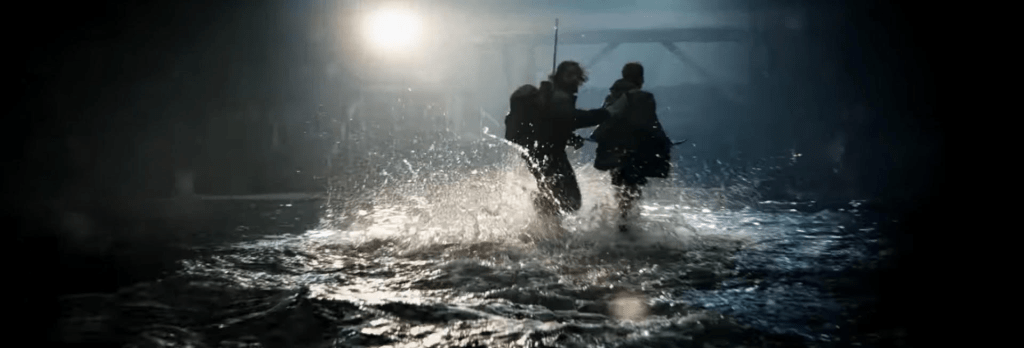
Things happen in this movie that are horrifying, but this is not a horror film. It’s a survival film. Rather than the elements or an animal the characters struggle against an infected population. It is also a coming-of-age story where a young boy must make difficult decisions and face harsh realities that cause him to leave childhood behind.
The story does not exactly ignore the 28 Weeks Later but it does not factor here. The rage virus that had made its way to mainland Europe was driven back with survivors in England left to fend for themselves. They were a terrifying blip which helps to mostly but not fully explain the world’s attitude towards the UK and any potential survivors.
We learn there are patrol boats circling the UK. Why? To keep people there. So do they believe everyone on the island is infected or at the minimum a carrier? Do they gun down people that make boats to cross to Europe? The only character that could logically answer those questions never does. On the one hand, you can question why the world wouldn’t try to do something but on the other you see in the history of mankind we tend to forget things and people when it’s no longer our problem.
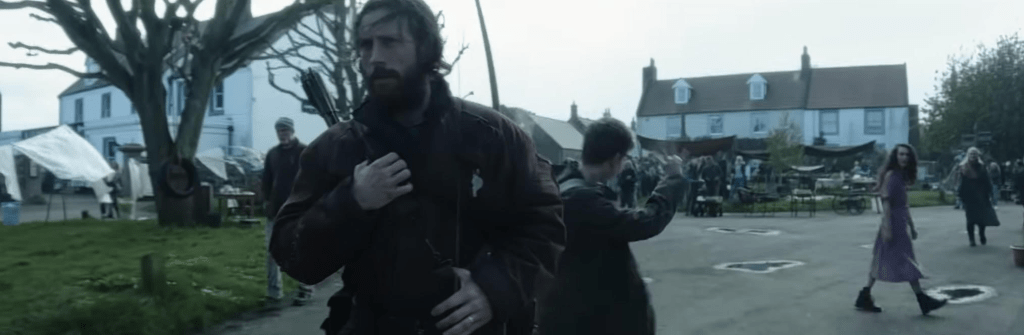
The only community we see in this is on Lindisfarne that can get to the mainland at low tide. They have taken on a mix of the tribal and the modern though their schools are geared towards creating a population that can survive their harsh reality. They have a very sturdy wooden wall though the immediate area lacks real trees. We only see real trees once the action gets further away. Given the savagery of the infected, how did they get enough wood?
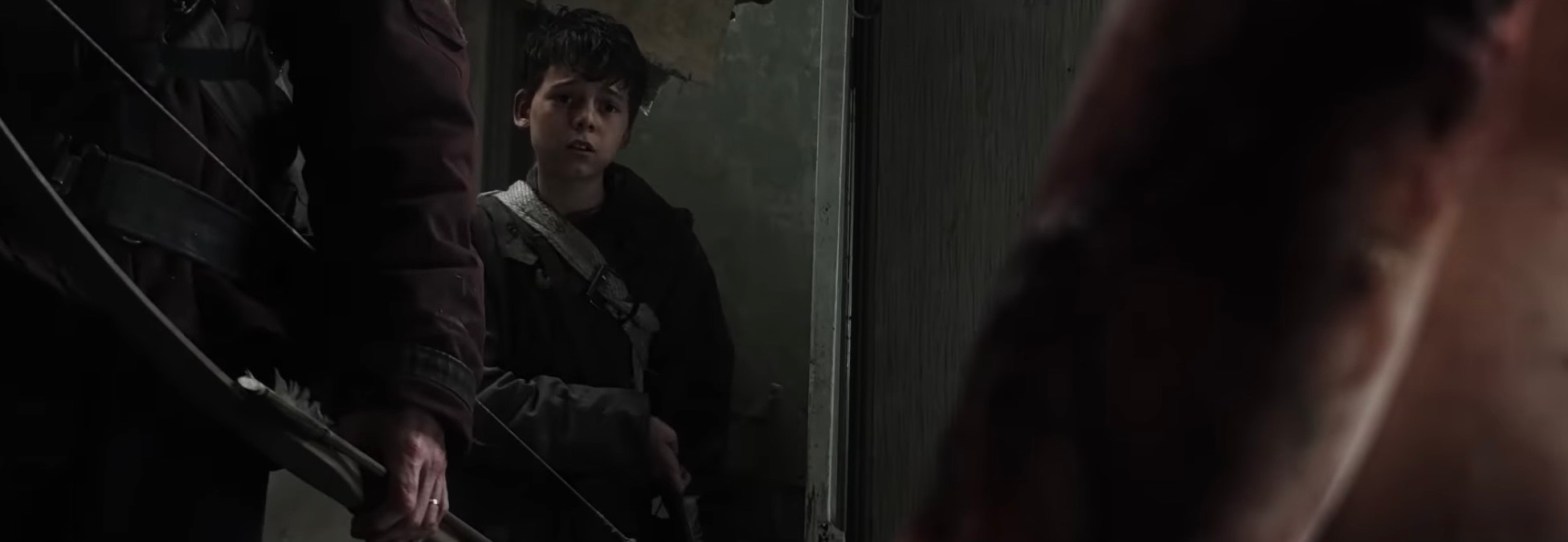
The main character is a young boy named Spike (Alfie Williams) who along with his father leaves the settlement in what amounts to a coming-of-age ritual where he must survive in the wilderness among the infected. Williams carries much of the film and is a talented young actor that never suffers from the weaknesses other young performers do. He even performs strongly in scenes with adults.
Spike’s mother Isla (Jodie Comer) has been having inexplicable swings between lucidity and insanity. Given the world they live in there is no help for her. Problems begin (or the main plot starts) when father Jamie (Aaron Taylor-Johnson) and son Spike stumble up Dr. Ian Kelson (Ralph Fiennes). Not sure how to feel about Jamie’s assessment of Kelson given the insanity of the lives they ALL lead. Looks like he stumbled across the man in his own jaunt which was with others leading me to so many questions. Were there no other kids Spike’s age this time around?
In true movie child fashion Spike gets it in his head that Kelson can cure his mom, so he decides to start a fire and sneak mommy out the front door. Boyle avoids the almost expected part where the boy screws everything up for the settlement. No hordes of the infected taking the moment of distraction as a time to attack. Everything seems okay (mostly) when we see them again. In fact, this film largely avoids the pitfalls of legacy sequels or reboots.
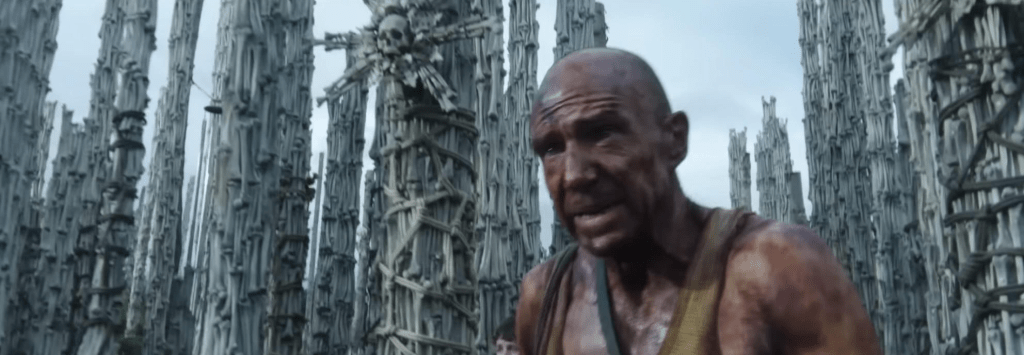
I expected Kelson to be much more of a threat, but he’s not one at all. He’s kind of nice and charming. A little weird but considering what we do know about him he’s probably pretty normal. What we do know of him is that, despite being alone largely if not entirely for his time, he survived quite well using his scientific knowledge. For Spike, Kelson is practically a dad raising a son dispensing wise advice for the world the child lives in. Never talking down to the boy but trying to get him to come grips with a harsh reality. The big pile of skulls he has does not even come as disturbing. His solution to Isla’s illness may be cold but is the best option.
28 Years Later is a slow burn movie. It takes its time but never feels laborous. It fits much more with the aesthetic of 28 Days Later than it does with 28 Weeks Later. It is even shot very similarly though it looks almost cleaner than the first film. The scenes in the wilderness are often kept quiet which gets your brain to thinking you and them are alone.
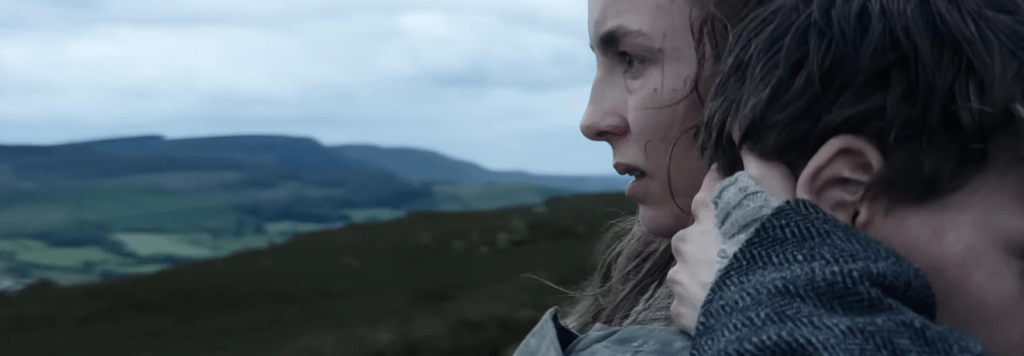
Nobody speaks or acts beyond their years. Their actions come off as possible and believable in the fiction that’s created. Even stupid kid doesn’t delve into obnoxious stuff because of his inherent stupidity. There is real change in the character. By the end he understands he needs some time to himself.
Nothing is really stylized or glamorized in this. Danny Boyle was not aiming for a pretty and visually stunning movie. He was aiming for an ugly and stark film that was a drama involving extraordinary things. Buildings are crumbling and the environment is quickly overtaking what was once civilization.
There are identifiable elements we can all understand. We get the father’s protective nature both from Kelson and of shielding the boy from what he probably understood was happening with his wife. Spike’s quest to save his mother can be viewed as him gripping to the last bit of his youth. We can all understand wanting to keep our parents around forever and help them.
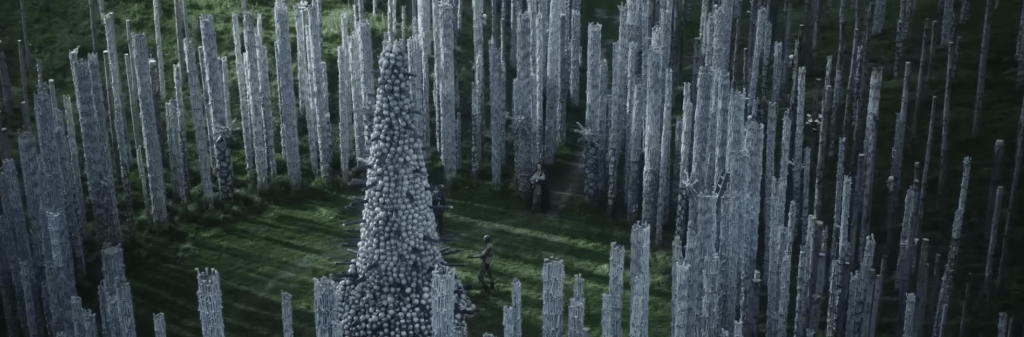
Even what Kelson did with the bones is understandable though weird. This is his way of remembering the dead. He’s perhaps a little more human than many of the other characters we meet. He’s not perpetually in survival mode, and he doesn’t write write people off once they pass. He’s found a way to hold onto his humanity and a small speck of civilization.
At the end of the movie Spike decides to spend some time on his own. A moment comes when he is about to be attacked by a group of infected and we meet The Jimmys. You might ask why style a group after Jimmy Savile if you know anything about the man. But put in the context of the films timeline, they would not have known most likely. If I recall correctly, the rage virus broke out before Savile and discovery was brought to life. They dressed in tracksuits in a mockery of the man.
Everything else in this movie is designed to show an authentic presentation of people living on the edge. Take away the rage virus and it’s a little more than a group of people living a very rustic life. Replace the rage people with wild animals and the story gets mediocre. The rage virus allows for a deeper understood examination of ethics and decisions when help is far away and easy answers are unavailable.
There is much more here than I expected. I had no idea how you could get a little over two hours. Right or wrong I assumed they would drag things out which would make for a long slog. There is always something going on to grow the world or move the story forward. There are no dead spots or boring periods moments.
28 Years Later is a rare reboot that gets things right. It doesn’t ignore anything that came before but instead logically takes it off the table. Using the foundation of the original film it creates a new story set in that reality that is excellent filmmaking.

