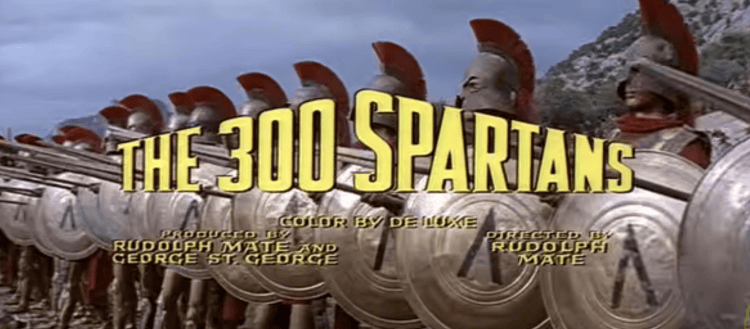
- Directed by Rudolph Maté
- August 29, 1962 (US)
A small force of Spartan warriors must stop the advancing Persian army of Xerxes.
As a film, The 300 Spartans is essentially a sword and sandals epic and possesses a very fun adventure feel for most of the movie. It’s a strange viewing experience knowing that this is based on historical events. The seriousness of what they’re facing coupled with how lighthearted everything is portrayed makes one expect a happy ending. This will decide the fate of their world and in hindsight was a turning point in history. King Leonidas (Richard Egan) is often smiling and laughing like a man at a cocktail party. Egan does well in the part but is limited in what he can do because Leonidas or the film often fails to seriously grapple with the situation.
It has been said there are Cold War connotations in this. Maybe. That is the best I can give on that. Having grown up in THAT era I should be able to pick up on such yet I have trouble seeing it. Are the Persians a stand in for Russia? There is a great deal of talk of Spartan democracy so maybe that is the connotation. You could almost see this as a call to patriotism. Spartans are fighting based largely on love of country. The Persians have a god king (an all-powerful state?) whose dictatorial rule clashes with the freedom loving Spartans.
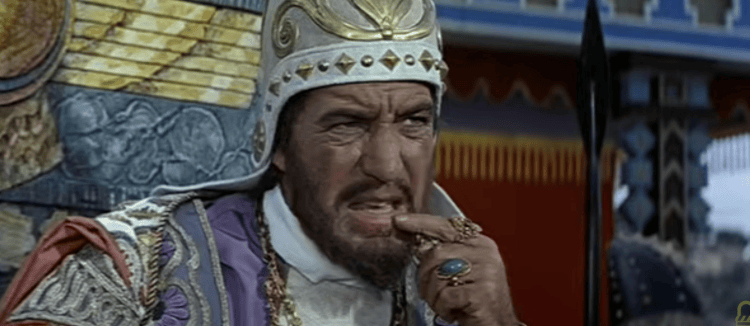
David Farrar looking a lot like Vincent Price did at the time is King Xerxes of Persia. Though the voice is not the same, he performs the would-be conqueror of ancient Greece much like Price may have approached the role. It is so close I had trouble NOT believing it was Price. It is equal parts ham and deadly serious with anger and condescension dripping from his words in equal measure.
For theatrical cred we get the great Ralph Richardson as Themistocles of Athens lending weight and depth in a sharp contrast to much of the rest of the film. Via his presence, references to creating Greek identity as some kind of dream are added but the script never does much to give that depth. Broad proclamations delivered by a skilled thespian to sound grandiose are only deep sounding.
Characterization is a little poor and there are some unnecessary subplots. The romance between simple Spartan soldier Phylon (Barry Coe) and the young Ellas (Diane Baker) gives (or tries) the story heart and tragedy but in the context if events portrayed adds little. It is one of those subplots that writers of a time added to make the audience feel bad without directing the pity at the hero or heroes. Leonidas issues and why he was so driven to risk going to war/stop an invasion when he was legally and religiously prevented from doing so never get delved into. His plan to use his personal guard is risky but you never get a clear feel of the costs.
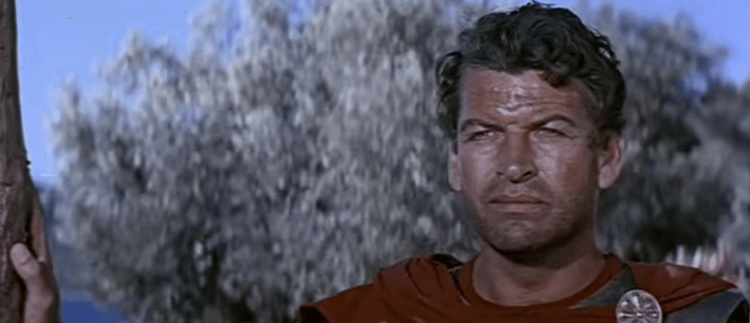
The performers do their best with the lines to at least draw you into the story despite characterization being poor. Perhaps the real hook is that while the politicians all sound like high-minded individuals (as one might hope), the soldiers are having a good time like the script intends. I keep circling back to that in my mind perhaps because ‘fun’ is no longer a common thing in cinema.
I found some of the battle scenes a little on the tepid side. I’ve watched numerous Biblical epics and even other films set in ancient times. It is surprising at how meek the action can get. Not the rousing crowd pleasers one might expect-pp. They were okay but of an almost a television nature rather than at theatrical nature. Some slightly quicker cuts, which could be found in other films from around then, were called for. Director Rudolph Maté opted for a more static approach to the camera and the footage.
I found stuff to enjoy. The plot held me even with George St. George’s screenplay giving everything a family touch. I can certainly see how The 300 Spartans appealed to a young Frank Miller enough to stick in his mind and cause him to create a graphic novel that was a fantasy version of this many decades later. It’s one of those things that’s going to hook a child and be fondly remembered by the adult that was once that child.
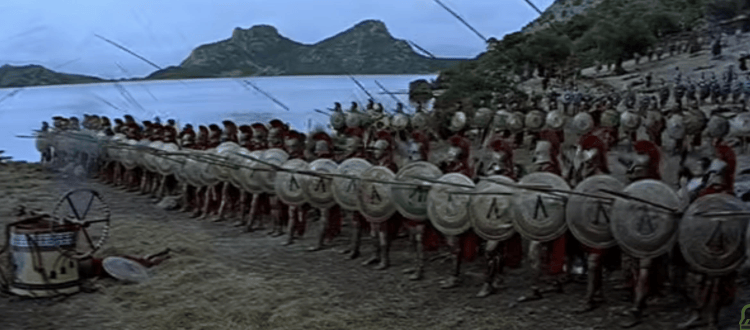
Produced in Cinemascope, it is a stunning movie to look at. It’s one of those things that you could turn the sound off and simply look at artfully framed and shot it is. The colors are bright and crisp. The sets like the action are closer to television quality than a comparable epic of the time. Costumes acted as a nice visual division between the opposing sides. The Greeks are much more subdued in their appearance than the Persians
Given the length of the movie, it does manage to cover most if not all the important points of the story. I think what hurts this movie is that it engages in the almost expected humor that such movies might have. They were aiming for a broader market and as such, it was expected that there were jokes and the tone was not as deep or serious as perhaps material warranted.
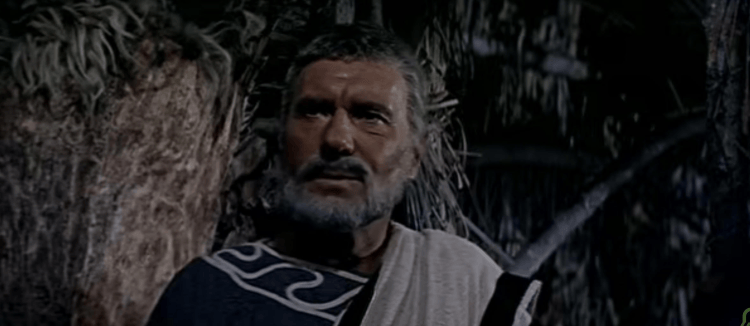
Ephialtes of Trachis (Kieron Moore), farm worker and eventual Greek traitor, is practically a minor character. Lip service is paid but the importance of what he did is downplayed. He is a cranky employee of a family that Phylon and Ellas meet on their way to the eventual Battle of Thermopylae. His background and what we know about the character is largely communicated by others. All we see is him often lurking in the background like a creep.
Perhaps not a perfect movie, The 300 Spartans is an acceptable rough draft for a historical epic. I think it needed a little editing in the battle scenes and less smiling after every line was delivered but still a good romp nonetheless.